Love this video about the work of the Jesus Centres. I'm particularly involved with the Coventry Jesus Centre, but have been to then all, and think they're all great.
Showing posts with label celebration. Show all posts
Showing posts with label celebration. Show all posts
Thursday, July 17, 2014

Friday, May 16, 2014
More beautiful broken
Two things spoke to me this week.
First some lines from T S Eliot's poem, East Coker:

First some lines from T S Eliot's poem, East Coker:
I said to my soul, be still, and let the dark come upon youThen this:
Which shall be the darkness of God...
I said to my soul, be still, and wait without hope
For hope would be hope for the wrong thing; wait without love
For love would be love of the wrong thing; there is yet faith
But the faith and the love and the hope are all in the waiting.
Wait without thought, for you are not ready for thought:
So the darkness shall be the light, and the stillness the dancing.
There's a depth can only come with brokenness; a hope can only come in darkness.
Selah.
Friday, December 06, 2013
Fishing for complement
 The fish was off. It almost all went wrong.
It’s not every day we have an apostolic leader (Jesus Army
speak for big leader) over for dinner. And the trout was off. Cue waiting at
the table while my ever-resourceful wife cooked up some chicken fillets
instead. But said leader amused my kids (and their dad) with optical illusion
videos on his phone and all was well.
Later we had a great evening talking about lots of things from
UK housing through to Pope Francis. Not surprisingly, given the rollercoaster
ride my wife and I have had this year, we talked about vision and disappointment
and community.
One issue we touched on that I thought would make a worthwhile
wee post was the difference between generations when it comes to their money
ethic. It ties into the wider discussion about intentional community – because
if you’re going to share your money, as we do in a common pursue, the way members
see money matters.
The older generation (his lot), we realised, prize
frugality. This is the generation whose parents negotiated rationing and making
frayed ends meet. For them ‘simplicity’ is about spending less. A community
lounge with faded curtains, ill-matching plastic chairs and patched-together
cushions is AS IT SHOULD BE.
The rising generation (our lot) prize liberality. This generation
hasn’t, by and large, grown up with scarcity. For this generation ‘simplicity’ is about
spending more on others. About not worrying about money, being generous and
spontaneous. A community lounge with simple, contemporary decor and plenty of (young)
people feeling at home is AS IT SHOULD BE.
Of course, the younger generation’s liberality can tip over
into profligacy – ‘want it nice, want it easy, want it now’. Likewise, the
older generation’s frugality can slide into parsimony – ‘if it’s not horrible,
it’s not holy’. And both sides can be inclined to characterise the other unfairly:
‘Wasters!’ ‘Misers!’
A better approach – as so so so often with these paradoxes –
is to take both views at once. As John Wesley said ‘Earn all you can, give all
you can, save all you can.’
Don’t waste God’s money; don’t be indulgent. Don’t
penny-pinch; don’t be miserable.
Or to put those things positively: Spend money joyfully and
remember that ‘God gives us richly all things to enjoy’ (1 Timothy 6:17); identify
with the world’s poor and remember that ‘if we have food and clothing, with
these we will be content’ (1 Timothy 6:8).
Jesus (funnily enough) got it right. ‘You can’t serve God
and money’, he warned. But he also said ‘Use wicked wealth to make friends’.
Simplicity is best. But if the fish is off don’t eat it.
Friday, October 25, 2013
Rapture kindled eye
What do Martin Luther King, Dietrich Bonhoeffer, Oscar Romero and Queen Victoria's granddaughter have in common?
Read on and I'll tell you.
Last Saturday was the Jesus Fellowship's annual 'Praise Day', a large-scale, stage-presentation style event run by my church each year in the International Hall at Ponds Forge, Sheffield.
Towards the end of the event, we very often have a special item in which we honour the martyrs of Christian history (followed almost always by a hearty singing of the hymn 'For all the saints' - it's the Jesus Army's version of All Saints Day). This year was no exception, and I was given the - somewhat awe-inspiring - task of coordinating the moment.
Inspiration came in the form of ten statues in Westminster Abbey. Standing above the West Gate on ten niches stand ten statues: ten twentieth century martyrs.

Maximilian Kolbe was a Polish friar, who volunteered to die in place of a stranger in the Nazi death camp of Auschwitz, during World War II. He is the patron saint of drug addicts, political prisoners and families. Pope John Paul II declared him "The Patron Saint of Our Difficult Century".
Manche Masemola was a South African convert to Christianity. She attended baptism classes against her parents’ wishes. When she came home she would be beaten. Manche said she would be “baptised in her own blood”. After one severe beating, Manche died – without having been baptised. Manche's mother denied murdering her for 40 years – but before her death she became a Christian and was baptised herself.
Janani Luwum was an Anglican Archbishop in Uganda. In 1977, Archbishop Luwum delivered a note of protest against arbitrary killings and unexplained disappearances to dictator, Idi Amin. Shortly afterwards the archbishop was accused of treason. He was murdered in 1977, by either Idi Amin personally or by the dictator’s henchmen.
Elizabeth of Russia was a German princess, granddaughter of Queen Victoria, and sister of the last Russian Empress. She was famous in Russia for her beauty – and for her charitable works. After a revolutionary murdered her husband in 1905, Elizabeth publicly forgave him and campaigned without success for him to be pardoned. She left the Imperial Court and became a nun, dedicated to helping the poor of Moscow. In 1918, she was arrested by the Bolsheviks and buried alive.
Martin Luther King was a Baptist minister and one of the world's most famous civil rights activists. In 1964, King received the Nobel Peace Prize for combating racial inequality through nonviolence. He was assassinated in 1969.
Oscar Romero was a Roman Catholic Archbishop in El Salvador. Following his outspoken criticism of injustice and violence on many occasions, he was assassinated while he was celebrating the Mass in 1980.
Dietrich Bonhoeffer was a German pastor, theologian, and prominent anti-Nazi. He strongly opposed Hitler and was involved in plans to assassinate him. He was arrested in April 1943 by the Gestapo, imprisoned in a concentration camp, and executed by hanging in April 1945. It was just 23 days before the German surrender.
Esther John was a Pakistani Christian nurse and evangelist who was murdered by a Muslim fanatic in 1960.
Lucian Tapiede was an Anglican teacher from Papua New Guinea. He was killed during the Japanese invasion in 1941. Eight Anglican clergy, teachers, and medical missionaries killed by the Japanese were together called the "New Guinea Martyrs."
Wang Zhiming was a Chinese pastor and evangelist, killed during the Chinese Cultural Revolution under Chairman Mao. Many Christian leaders were imprisoned, denounced or beaten. One later stated, "I cannot recall how many times I was made to kneel on the rubble and how much blood flowed from my knees due to their sharp edges. When I could not hold out and fell to the ground, merciless beatings followed. Then I was pulled up and forced to salute the portrait of Chairman Mao. My refusal to do so resulted in another round of beating.” Wang Zhiming was executed in a stadium in front of more than 10,000 people on December 29, 1973.

With a huge picture of their statues projected across the backdrop, and signs to represent them and the thousands of others who have given their life as a direct result of their consciencious stand for Christ, their stories were told. A minute's silence was held in their honour. It was an awesome moment. Then we did indeed sing 'For all the saints' - with this rarely sung verse included:
For Martyrs, who with rapture kindled eye,
Saw the bright crown descending from the sky,
And seeing, grasped it, Thee we glorify.
Alleluia, Alleluia!
Read on and I'll tell you.
Last Saturday was the Jesus Fellowship's annual 'Praise Day', a large-scale, stage-presentation style event run by my church each year in the International Hall at Ponds Forge, Sheffield.
Towards the end of the event, we very often have a special item in which we honour the martyrs of Christian history (followed almost always by a hearty singing of the hymn 'For all the saints' - it's the Jesus Army's version of All Saints Day). This year was no exception, and I was given the - somewhat awe-inspiring - task of coordinating the moment.
Inspiration came in the form of ten statues in Westminster Abbey. Standing above the West Gate on ten niches stand ten statues: ten twentieth century martyrs.

Maximilian Kolbe was a Polish friar, who volunteered to die in place of a stranger in the Nazi death camp of Auschwitz, during World War II. He is the patron saint of drug addicts, political prisoners and families. Pope John Paul II declared him "The Patron Saint of Our Difficult Century".
Manche Masemola was a South African convert to Christianity. She attended baptism classes against her parents’ wishes. When she came home she would be beaten. Manche said she would be “baptised in her own blood”. After one severe beating, Manche died – without having been baptised. Manche's mother denied murdering her for 40 years – but before her death she became a Christian and was baptised herself.
Janani Luwum was an Anglican Archbishop in Uganda. In 1977, Archbishop Luwum delivered a note of protest against arbitrary killings and unexplained disappearances to dictator, Idi Amin. Shortly afterwards the archbishop was accused of treason. He was murdered in 1977, by either Idi Amin personally or by the dictator’s henchmen.
Elizabeth of Russia was a German princess, granddaughter of Queen Victoria, and sister of the last Russian Empress. She was famous in Russia for her beauty – and for her charitable works. After a revolutionary murdered her husband in 1905, Elizabeth publicly forgave him and campaigned without success for him to be pardoned. She left the Imperial Court and became a nun, dedicated to helping the poor of Moscow. In 1918, she was arrested by the Bolsheviks and buried alive.
Martin Luther King was a Baptist minister and one of the world's most famous civil rights activists. In 1964, King received the Nobel Peace Prize for combating racial inequality through nonviolence. He was assassinated in 1969.
Oscar Romero was a Roman Catholic Archbishop in El Salvador. Following his outspoken criticism of injustice and violence on many occasions, he was assassinated while he was celebrating the Mass in 1980.
Dietrich Bonhoeffer was a German pastor, theologian, and prominent anti-Nazi. He strongly opposed Hitler and was involved in plans to assassinate him. He was arrested in April 1943 by the Gestapo, imprisoned in a concentration camp, and executed by hanging in April 1945. It was just 23 days before the German surrender.
Esther John was a Pakistani Christian nurse and evangelist who was murdered by a Muslim fanatic in 1960.
Lucian Tapiede was an Anglican teacher from Papua New Guinea. He was killed during the Japanese invasion in 1941. Eight Anglican clergy, teachers, and medical missionaries killed by the Japanese were together called the "New Guinea Martyrs."
Wang Zhiming was a Chinese pastor and evangelist, killed during the Chinese Cultural Revolution under Chairman Mao. Many Christian leaders were imprisoned, denounced or beaten. One later stated, "I cannot recall how many times I was made to kneel on the rubble and how much blood flowed from my knees due to their sharp edges. When I could not hold out and fell to the ground, merciless beatings followed. Then I was pulled up and forced to salute the portrait of Chairman Mao. My refusal to do so resulted in another round of beating.” Wang Zhiming was executed in a stadium in front of more than 10,000 people on December 29, 1973.
*

With a huge picture of their statues projected across the backdrop, and signs to represent them and the thousands of others who have given their life as a direct result of their consciencious stand for Christ, their stories were told. A minute's silence was held in their honour. It was an awesome moment. Then we did indeed sing 'For all the saints' - with this rarely sung verse included:
For Martyrs, who with rapture kindled eye,
Saw the bright crown descending from the sky,
And seeing, grasped it, Thee we glorify.
Alleluia, Alleluia!
Tuesday, July 09, 2013
Perfect radio face

I'd come to give a radio interview, but neither the red phone by the door ('call to access Premier Christian Media'), nor urgent knocking, nor even phoning the 0800 number I'd been emailed, seemed to be getting me any closer to actually getting into the place.
This would have been a shame; many of my friends tell me I have the perfect face for radio.
I persevered. On trying the 0800 number a second time, I reached an apologetic chap who'd been answering a call of nature for the previous eight hours. Or so it seemed to me. He let me in.
Premier is a fairly large concern, judging by its spacious open-plan offices with room for a hundred or so - then empty it being Saturday, apart from me, the (now-relieved) doorman, and Nage, the presenter who would interview me (at that point live in the studio). Nage (pronounced 'Naj') later told me that 'The Big Breakfast', the show in which I would feature, has about half a million listeners.
 Why was I there? Last Saturday was 'London Jesus Day', a colourful event hosted by the Jesus Army in central London. More than a thousand Christians marched from Hyde Park Corner via Picadilly Circus to Trafalgar Square where a lively rally was held for a few hours. It was nothing to do with protest and everything to do with celebration.
My chat with Nage went went well, I think. Or at any right that's what two very important people told me, in texts sent straight after I went off air (my boss and my mum).
And yes, a number of Premier's half a million listeners came along to the event. A number a little lower than half a mil, it's true - but I'm still glad I made that 0800 call a second time.
Have a listen. The event happened last Saturday, so you've missed it this year! But, all being well, we'll be doing it again next year - so why not look out for the date and come along an join us? All are welcome; the more, the merrier.
Wednesday, April 24, 2013
Woe is me, I'm so spiritual
It’s a miserable business being holy, isn’t it?
I remember a time, not long after I’d joined the Jesus Army, when I returned to my home town for a few days. While I was there I visited a friend, a young woman who’d played a pivotal role in my faith coming alive a few years earlier when I was 16.
She was charismatic (in both a theological and sociological sense) and attractive (ditto re theology, sociology, and let’s throw in biology for fun). A succession of guys had fallen for her (I, as it happened, had avoided this through the unforeseen and useful happenstance of falling for her sister instead).
Anyway, I wanted to make an impression. After all, had I not just discovered the best church in the nation, nay the world? I was gearing up for a life in intentional community. Hang it all, I was weighing up a call to holy celibacy. (That this didn’t come to pass was not due to my friend’s sister, I ought to say, but rather to the radiant creature who is now my wife. I didn’t know that – or her – at the time.)
I wanted to impress. I’d discovered something wonderful. I wanted her to know it. I didn’t deliberately try to look holy, I promise. But I did, nonetheless, try to look holy. My desire to convey the specialness of what I’d discovered manifested in a manner that was forcedly “spiritual”. And, with hindsight, downright miserable.
I’d wanted to foster an air of spirituality; I succeeded in coming across as depressive. My other-worldly air was woeful, my long meaningful silences stultifying. My attempt at gravitas was, in fact, just grave. Not surprisingly, my friend wrote to me not long after that visit to express some concern for me having lost my spark. She was troubled. I seemed unhappy.
I can look back and laugh now. And I think my friend has been long since reassured that I am, in fact, happy. Today, on Facebook, I saw a picture of her on some beach somewhere, the happy (if not entirely willing) subject of a photograph which I noted (thanks Facebook) was taken by a photographer with whom she is now "in a relationship". I smiled, happy for her. My memory drifted back to other happy memories, and back to that day of my forced solemnity. That’s why I write about it now.
Why is it, I wonder, that we often associate holiness with unhappiness? Misery as a measure of sanctity?
Check out this cheerful saint, Julian of Norwich. It was once suggested to me that maybe she looks so miserable because she’s been saddled with a bloke’s name. But I suspect that hagiographers painted her sad simply because she’s a saint. Looking sad is what saints do, isn’t it?
Check out Saint Francis, the new pope’s namesake.
Not exactly full of the joys of spring, eh? Even the bird in his hand looks like he'd rather be one of the two in the bush.
And before my dear Protestant readers spot an opportunity for controversy and start on about “Catholicism's attachment to unbiblical asceticism” or such like, check out these two Reformation pillars, Martin and John.
Fancy an evening down at the pub with either of these two gents? (Not unless you want your party well and truly pooped.)
And let’s not even start on pictures of Jesus. Do a Google image search for “Jesus” if you dare. Once you’ve got over the fact that most of the results look like women (note to self: topic for future post) you'll notice you’re staring at a sea of miserable faces. Was Jesus, that magnetic gatherer of the common people, really so epically po-faced?
Why do these heroes of holiness all look like they could do with watching all twelve episodes of Fawlty Towers back to back? Why so miserable, Julian, Francis, Martin, John?
There is, of course, something to be said for the calling of God’s people, shaped as they are in the image of God’s Messiah, to carry the world’s sorrows. To pray with groans. To weep with those who weep. But this cannot be the whole story. Jesus skipped with delight when he saw his Father at work. Peter described a similar experience as “joy unspeakable”. Paul, writing to the Philippians, is positively bubbly (ironically, he was in prison waiting for the chop at the time of writing). We’re to rejoice with all who rejoice.
Put simply, to be holy does not mean to be unhappy. Holiness makes laughter and tears deeper. Holiness means that beyond happiness and unhappiness there is joy. The road of holiness is one along which a cross is carried, yet the destination makes the journey jubilant.
One of my favourite quotations from across the panoply of Christian saints is ascribed to Teresa of Avila – “From silly devotions and sour-faced saints, good Lord deliver us!” Teresa is the same down-to-earth saint who advised her followers, if struck with melancholia and overdoing the “sighing saint” bit, to “eat a good steak and have a hot bath”.
I’m happy to be holy. But I’m not very holy, yet, which is why I’m not always happy. The holier I become the happier I’ll be – whether I’m laughing or crying. And when God wipes away every tear, I’ll be happy – because I'll be holy – forever.
And as for “rejoicing when others rejoice” – I'm so glad my friend's happy on that beach with her photographer. To her I joyfully dedicate this post.
I remember a time, not long after I’d joined the Jesus Army, when I returned to my home town for a few days. While I was there I visited a friend, a young woman who’d played a pivotal role in my faith coming alive a few years earlier when I was 16.
She was charismatic (in both a theological and sociological sense) and attractive (ditto re theology, sociology, and let’s throw in biology for fun). A succession of guys had fallen for her (I, as it happened, had avoided this through the unforeseen and useful happenstance of falling for her sister instead).
Anyway, I wanted to make an impression. After all, had I not just discovered the best church in the nation, nay the world? I was gearing up for a life in intentional community. Hang it all, I was weighing up a call to holy celibacy. (That this didn’t come to pass was not due to my friend’s sister, I ought to say, but rather to the radiant creature who is now my wife. I didn’t know that – or her – at the time.)
I wanted to impress. I’d discovered something wonderful. I wanted her to know it. I didn’t deliberately try to look holy, I promise. But I did, nonetheless, try to look holy. My desire to convey the specialness of what I’d discovered manifested in a manner that was forcedly “spiritual”. And, with hindsight, downright miserable.
I’d wanted to foster an air of spirituality; I succeeded in coming across as depressive. My other-worldly air was woeful, my long meaningful silences stultifying. My attempt at gravitas was, in fact, just grave. Not surprisingly, my friend wrote to me not long after that visit to express some concern for me having lost my spark. She was troubled. I seemed unhappy.
I can look back and laugh now. And I think my friend has been long since reassured that I am, in fact, happy. Today, on Facebook, I saw a picture of her on some beach somewhere, the happy (if not entirely willing) subject of a photograph which I noted (thanks Facebook) was taken by a photographer with whom she is now "in a relationship". I smiled, happy for her. My memory drifted back to other happy memories, and back to that day of my forced solemnity. That’s why I write about it now.
Why is it, I wonder, that we often associate holiness with unhappiness? Misery as a measure of sanctity?
 |
| Julian of Norwich |
 |
| Francis of Assisi |
Not exactly full of the joys of spring, eh? Even the bird in his hand looks like he'd rather be one of the two in the bush.
And before my dear Protestant readers spot an opportunity for controversy and start on about “Catholicism's attachment to unbiblical asceticism” or such like, check out these two Reformation pillars, Martin and John.
 |
| Martin Luther |
 |
| John Calvin |
And let’s not even start on pictures of Jesus. Do a Google image search for “Jesus” if you dare. Once you’ve got over the fact that most of the results look like women (note to self: topic for future post) you'll notice you’re staring at a sea of miserable faces. Was Jesus, that magnetic gatherer of the common people, really so epically po-faced?
Why do these heroes of holiness all look like they could do with watching all twelve episodes of Fawlty Towers back to back? Why so miserable, Julian, Francis, Martin, John?
There is, of course, something to be said for the calling of God’s people, shaped as they are in the image of God’s Messiah, to carry the world’s sorrows. To pray with groans. To weep with those who weep. But this cannot be the whole story. Jesus skipped with delight when he saw his Father at work. Peter described a similar experience as “joy unspeakable”. Paul, writing to the Philippians, is positively bubbly (ironically, he was in prison waiting for the chop at the time of writing). We’re to rejoice with all who rejoice.
Put simply, to be holy does not mean to be unhappy. Holiness makes laughter and tears deeper. Holiness means that beyond happiness and unhappiness there is joy. The road of holiness is one along which a cross is carried, yet the destination makes the journey jubilant.
One of my favourite quotations from across the panoply of Christian saints is ascribed to Teresa of Avila – “From silly devotions and sour-faced saints, good Lord deliver us!” Teresa is the same down-to-earth saint who advised her followers, if struck with melancholia and overdoing the “sighing saint” bit, to “eat a good steak and have a hot bath”.
I’m happy to be holy. But I’m not very holy, yet, which is why I’m not always happy. The holier I become the happier I’ll be – whether I’m laughing or crying. And when God wipes away every tear, I’ll be happy – because I'll be holy – forever.
And as for “rejoicing when others rejoice” – I'm so glad my friend's happy on that beach with her photographer. To her I joyfully dedicate this post.
Tuesday, April 23, 2013
Saint George the internationalist
Happy Saint George's Day – that day when English patriotism swells in English breasts and St George's cross (the English flag) can be seen flying from windows and fences around the nation. This the day when our Prime Minister is prompted by that Saint Georgish feeling to declare how very 'proud' he is 'to be English and British'.
 Saint George, as it happens, was not English. He was Greek. He served in the Roman army. He travelled the Near East before he was martyred under Emperor Diocletian. He was nothing if not cosmopolitan.
I love this beautiful island nation, too. Yet, with cosmo George the martyr in mind, I pray that Britain's greatness will not be walled in and hoarded by the Saxo-Normans who happen to form the racial and cultural majority in our era. I pray that we can be a nation with an open welcome and a generous outlook to those of other nationalities and races – and in particular those who have suffered hardship or persecution or threat of death elsewhere.
It's what George would have wanted.
Monday, January 14, 2013
Learning from Margaret

A thanksgiving service for her life was held last week, in which moving testimonies were shared about how much Margaret had meant to many.
For me Margaret was a fascinating friend: on car journeys to and from her house on the edge of the city, she would regale me with tales of the War, and of her experience as a nurse. Yet in recent years, since Margaret has been quite frail and ill, she ministered to me in a new, unexpected, way. Visiting her in the nursing home she was living in, she brought me peace and taught me Sabbath.
By this time her conversation was less scintillating (though not without its fascinating flashes). Memory was failing, sight had almost gone. But Margaret had a quality of 'being'. Her life had deepened as it slowed down. Once I went to see her a little desperate because of a series of discouraging events. I spent a quiet hour with Margaret, during which she listened. I remember she said 'Sometimes things go well. And then they stop. And then they go well again.' You may not think this is all that profound, but I tell you it's what I needed to hear.
Margaret's 'being-ness' brought me back to peace.
Reading something Walter Brueggemann wrote reminded me of my times with Margaret. Speaking of the commandment to honour one’s aging parents, he writes:
"[This commandment] is closely related to the Sabbath. It, too, insists that human worth cannot be assessed in terms of economic productivity. Parents who may be belittled because they are no longer productive are indeed special candidates for Sabbath, endlessly at rest, Sabbath-enacting members of the community"We need "Sabbath-enacting members" of our community. They keep us sane.
For this, and for much much else besides, I give thanks for Margaret.
Here is a video, made by Margaret's son, Jon, to mark her passing and celebrate her life:
Thursday, October 25, 2012
Friends make friends
 'What I'd really like is a pint of freshly squeezed orange juice!' One of our house family was feeling rough last night. One of those lingering colds. Hearing his orange juice longing, my 9-year-old daughter and I nipped out to a local store and got him a carton of posh Clementine juice. I think he was well-blessed.
Friendship is priceless.
There's a bit of a catchphrase round our place at the moment: 'friends make friends'. When we're truly friends with each other, it's attractive; others want to join in.
So we've been upping the importance of friendship in our household (by 'household' I mean not only those of us who live in our community house, but our wider circle of members and friends, too). We all know, somewhere in our bones, that friendship is simply the best thing in life. But we need to hear it sometimes, especially when busyness and clashing priorities can seem so pressing. And also because friendship - just chilling together, enjoying each other, laughing, playing - can seem somehow less spiritual than, for instance, all closing our eyes and singing a Matt Redman song.
I think that's a mistake. Friendship is centre stage, not in the wings.
There's a beautiful little bit tucked away at the end of one of the smaller letters in the New Testament: 'The friends greet you. Greet the friends, every one of them.' (3 John 15) Christians are called 'friends'. Not 'members' (powerful word if it means parts of one body, less so if it means belonging to a club); not even 'brethren'; but friends.
There have been many attempts to define friendship, some of which make good fridge magnet type quotations. 'Friendship is a single soul dwelling in two bodies'. That's Aristotle, y'know (thanks Google). 'A friend is someone who knows all about you and still likes you.' That sort of thing.
I like some of the biblical proverbs about friendship:
A friend loves at all times, and a brother is born for adversity. (Proverbs 17:17) 'That's what friends are for' they say about help given in hard times. True word that.
A man of many companions may come to ruin, but there is a friend who sticks closer than a brother. (18:24) There's something about friendships formed in Christ which has the potential to run deeper by far than even family ties - and certainly deeper than just those we sit next to once a week on Sunday.
Faithful are the wounds of a friend; profuse are the kisses of an enemy. (27:6) We usually take this to mean that the truthful reality of a friend is worth a lot even when it hurts - which is true. But I also wonder if it may include the idea that it's better to be hurt unintentionally by a true friend than to lap up the false blandishments of a false friend. Certainly I've been often hurt by my friends in Christ - but they're still my true friends and I ought to remember this. Mustn't let offence rob me of that.
Oil and perfume make the heart glad, and the sweetness of a friend comes from his earnest counsel. (27:9) Beautiful. There's nothing quite like heart-to-heart honesty with a dear, deep friend.
So we're into friendship: meals round friends' houses; parties with treacle toffee; days out together; games; laughter; nicknames; prayers.
We want a widening circle of friends. Life affords nothing better.
Monday, October 15, 2012
Everyone valued
 I love being in a people-loving church of zero-prejudice.
Two Facebook statuses by different friends, both in the Jesus Army, stuck out to me this morning. Here's the first, referring to our big bash in Sheffield last Saturday:
I am proud of my church, the Jesus Army. We have slogans "All accepted, none rejected" and "Where everyone is valued." Saturday in Sheffield demonstrated, once again, that it doesn't matter how people classify you: by race, colour, gender, age, sexual orientation, previous religion, history, class or any other "box", you can be accepted as a full member of the church.And the second from another friend:
The last few days have been a stark reminder that life is all about the people... Those who are gone, those who are here, those who are far away and those who are near. They all shape you, make you and change you. Its the people that make life what it is and its those people that remember what you made of life when you're gone. Thanking God for the people in my life, those that have been, and those people making life what it is!I believe that in our time the church must earn its right to speak into our culture. It earns that right not by seizing or protecting power, not by intoning or preaching from some lofty height, but by - truly, demonstrably, authentically - loving all people everywhere.
I'm glad to be part of a church that is at least trying to do just that.
Friday, September 21, 2012
Of making many books...
This year I’m only reading novels that were written since I was born.
About a decade ago, I decided to get more deliberate about my reading. I’m a voracious reader, and it’s a good thing. As well as being a pleasure and a calming influence, it widens horizons. But I found the down side of being a confirmed readaholic, sob, an incurable bibliophile, is that reading can become hotchpotch, undisciplined, all over the place. Simply put, I just read whatever my hands fell on.
So about ten years ago I decided to have a reading theme for that year: biographies and autobiographies. That year, among others, I was inspired by Nelson Mandela, intrigued by Mikhail Gorbachev, appalled by Adoph Hitler, even more appalled by Joseph Stalin, challenged by George Fox, melted by Mother Teresa, and upbraided by John Wesley. I think I can honestly say some of the people I met that year changed by life.
 Since then, I’ve adopted a reading theme each year. In the myth year I sailed with Odysseus and believed in the Valar. My theology year saw me getting my teeth into Karl Barth and revisiting my old mentor Augustine of (humorously named) Hippo. Children’s books! That was fun and included spending several summers in one year on deck with the Swallows and Amazons. Science and sci-fi was out of my usual orbit but none the worse for that (I meant to work from physics through chemistry to biology, but never got beyond physics, it was so fascinating – H.G. Wells kept me entertained between the pencil chewing.) The first thousand years BC presented the challenge of fitting a millennium into a year, which I managed with the help of Edward Gibbon’s Decline and Fall of the Roman Empire, which is quite simply one of the most marvellous things I’ve ever read. And the classics year meant I finally got round to reading Pride and Prejudice and, yes, it really is as good as everyone says it is.
I don’t stick to my theme absolutely rigidly. I’ve usually got one or two Christian or theological books on the go, and I read the Bible and the Times most days. But it’s helped to add some deliberateness to my reading. As with the rest of life, rules and discipline help as long as we deliberately break them now and again.
So this year I’m on novels written since I was born. Since I was born in 1976 this means that I’m having a fairly post-modern year, and rather enjoying it. Life of Pi and Captain Corelli’s Mandolin combined profundity with humour rather excellently. The Wasp Factory made me itch with discomfort. Atonement was brilliantly written and played a trick on me which I quite enjoyed (though I know some people it annoyed). The English Patient was a bit pretentious which is probably why I liked it. Beloved was achingly sad. The Colour Purple was brilliant yet odd. The Blind Assassin was clever and engaging until it became too long. The Road was nihilistic and life-affirming by turns. Love in a Time of Cholera was poetry in motion. The Hunger Games was, I thought, quite brilliant, genuinely moving by the end of the trilogy, and none the worse for being 'popular'.
What’ll it be next year? The complete works of René Goscinny and Albert Uderzo? That's seriously tempting. Poets and poetry? Other people’s diaries? Who can say.
'Of making many books there is no end', said Solomon. He meant it as a complaint, I think. But I’m rather glad.
Monday, June 11, 2012
Full volume
 On Saturday, the Jesus Army turned up its collective, creative, technical, organisational, inspirational volume to full.
More than a thousand of us marched (danced, sang and pirouetted) our way from Hyde Park Corner to Traflagar Square. There we celebrated Jesus for three hours with music, dance, drama, testimony...
It was a great day. The sun shined (as did the Son).
One of the best things we ever do...
(Have a look at some more pics at the JA Facebook page, here.)
Wednesday, April 04, 2012
A rather wonderful quotation
 Paul has spoken, and we must speak, of the love of the one, true God. This love of God calls across the dark intervals of meaning, reaches into the depths of human despair, embraces those who live in the shadow of death or the overbright light of present life, challenges the rulers of the world and shows them up as a sham, looks at the present with clear faith and at the future with sure hope, overpowers all powers that might get in the way, fills the outer dimensions of the cosmos, and declares to the world that God is God, that Jesus the Messiah is the world's true Lord, and that in him love has won the victory.
~ N.T. Wright, in his commentary on Romans
Monday, February 20, 2012
Miracle!
 I just had an animated phone call from my wife.
A young woman who we’ve been praying for had just phoned her. This young woman is pregnant and there have been serious complications with the pregnancy. The medics said there was some sort of ‘band’ around the child which meant she was very likely to be born seriously deformed and therefore disabled.
We’ve been praying for this woman and her baby, and her partner. We met them some months ago; they’ve been coming round to our community, becoming our friends, finding faith bit by bit. Life is chaotic for them (as for so many families we meet, where the norm is anything but stable family life).
The other day, this young woman tried praying for the first time. She prayed for her mum who desperately needed a new place to live and was excited when, just hours later, her relieved mum rang to tell her she’d found a suitable place.
The other day she said to my wife, “Praying works!”
Then, today, she went to the hospital to find... no ‘band’ around the baby. Prognosis: normal birth. No reasonable medical explanation. They were both, understandably, awed.
They know we’ve been praying.
It does seem that God moves in simple miracle answers towards those who are just finding faith, just being reborn. (Conversely, when we’ve been believers for longer, things are often less ‘open and shut’ – partly I think because God gets to work on our character, teaching us patience and trust...)
God is loving and good. He’s a faithful Father to all his children – and especially to his newborns.
Tuesday, January 24, 2012
A remarkable healing
Our church is one big hallelujah at the moment.
Tom, a young man who lives in one of our communities went blind six months ago, due to a rare, genetically-inherited condition called Lebers Hereditary Optic Neuropathy. It was very hard for his friends to see him suffering - and, of course, desperately difficult for Tom himself.
On Sunday night, Tom reached a breakthrough moment and re-committed himself to Jesus. This, in itself, was cause for joy as Tom found he was able to reach beyond the pain and literal darkness of the past six months and place his trust in Jesus again. But who would have predicted what followed?
 Waking very early in the morning, Tom found to his astonishment - and excitement - that he could see! It wasn't long before the whole house was awake. It was true! Tom can see! Celebrations erupted. Yesterday the news was spreading round our churches.
This was the account given by Ian Clifford, the pastor of Tom's community:
I had the privilege of seeing Tom later that day, just briefly, through the window of my workplace. But - get this! - Tom saw me! He waved at me. My eyes welled with tears, I don't mind saying.
Should we be surprised? After all, we believe in miracles. We're supposed to expect them. We sing about them. We pray for them. But, flog the dogs, when a blind man sees - a blind man we know and love and have prayed for many times - that's cause for celebration.
Read the accounts of Tom's close friends: Aidan's is here (with some fascinating details from Tom's journey to healing as well); Jane's is here. Nathan's is here.
Tom, a young man who lives in one of our communities went blind six months ago, due to a rare, genetically-inherited condition called Lebers Hereditary Optic Neuropathy. It was very hard for his friends to see him suffering - and, of course, desperately difficult for Tom himself.
On Sunday night, Tom reached a breakthrough moment and re-committed himself to Jesus. This, in itself, was cause for joy as Tom found he was able to reach beyond the pain and literal darkness of the past six months and place his trust in Jesus again. But who would have predicted what followed?
 Waking very early in the morning, Tom found to his astonishment - and excitement - that he could see! It wasn't long before the whole house was awake. It was true! Tom can see! Celebrations erupted. Yesterday the news was spreading round our churches.
This was the account given by Ian Clifford, the pastor of Tom's community:
"Tom came to faith in Jesus beginning of last year. Soon after he lost his sight in one eye and then a couple of weeks after lost sight in the other. The doctors diagnosed it as Lebers Hereditary Optic Neuropathy. He could see literally a few inches in front of him but that was very blurred and could only recognise some slight colour. His eyes couldn't cope with any form of light and had to keep his eyes covered with sunglasses.
"The doctors said he'd be permanently like this. Many people have been praying ever since.
"In the midst of all this he continued to live for Jesus although at times his faith was shaken. Last night he re-dedicated his life to Jesus afresh and then woke up at 5:15 to go to the toilet. Suddenly realised he could see and woke the whole house, we've been celebrating ever since."
I had the privilege of seeing Tom later that day, just briefly, through the window of my workplace. But - get this! - Tom saw me! He waved at me. My eyes welled with tears, I don't mind saying.
Should we be surprised? After all, we believe in miracles. We're supposed to expect them. We sing about them. We pray for them. But, flog the dogs, when a blind man sees - a blind man we know and love and have prayed for many times - that's cause for celebration.
Read the accounts of Tom's close friends: Aidan's is here (with some fascinating details from Tom's journey to healing as well); Jane's is here. Nathan's is here.
Tuesday, January 17, 2012
Good
One of the reasons I love our church is that we know how to make sharing the gospel fun. Check out this video of a recent Jesus flash mob in Northampton:
On the theme of the gospel, check out this interesting blog post from Kurt Willems' Pangea Blog in which he makes the intriguing point that the important thing about the good news is that it is good - and that how we frame the content is secondary. (I'm not sure I fully agree, but he got me thinking before 10 o'clock in the morning, for which - hat off!)
On the theme of the gospel, check out this interesting blog post from Kurt Willems' Pangea Blog in which he makes the intriguing point that the important thing about the good news is that it is good - and that how we frame the content is secondary. (I'm not sure I fully agree, but he got me thinking before 10 o'clock in the morning, for which - hat off!)
Monday, July 25, 2011
Stop. Look. Listen.
 We're a community often at full tilt, so often doors open, welcome-all-comers, so it's important to have the odd occasion when, as the old road safety mantra put it, we 'stop, look and listen'.
Stop and appreciate the community God has made us. Look with fresh eyes. Listen to each other, and by doing that, perhaps, discern a fresh word from God.
Tonight we're doing just that. All our 'house family' (those who live and share life in the community house) are staying in; we've asked others, for tonight, not to come round. We're having a romantic evening in.
First a celebratory three-course meal (what are we celebrating? one another of course, with glorious unapologetic abandon). Then a couple of our sisters have something up their sleeves to get us opening up our hearts and minds to each other a bit. Then, we'll pile into the lounge for hot drinks and - later for those who want - we're going to project a nature programme onto the wall and be wowed by some elephants and their friends.
I hope we’ll all enjoy it (this can be a challenge as I’ve written before here and here). As an old Jesus Army song (so old, it was written before the Jesus Army was even called the Jesus Army) has it –
Slow down and appreciate your brother. Contemplate the grace of God in him...
Friday, April 08, 2011
Two weddings and a resurrection
 I haven’t blogged for quite some time. Not to get whiney with excuses, but life gets so busy. No really, it does: tomorrow some good friends and members of our church house group are getting married and holding their reception in our community house and garden. I’m speaking at the wedding. And the week after that, a brother from our community house is getting married – and I’m the best man.
I think I now stand justified in having been a little busy.
Anyway, all these nuptials have got me thinking about marriage. It’s been hard to think of much else.
My father-in-law wisely says, “There are three really important ingredients in a successful marriage: communication, communication, communication.” (More than a hint of Blairishness in this utterance, but I like it nevertheless.)
My wife and I have been meeting Mat and Georgia for the past few weeks, talking through marriage. A lot of what we’ve talked about that makes for a healthy marriage comes down to good communication; open, honest, frequent communication.
Anyway, at their wedding I’m going to talk about the story in the John’s Gospel when Jesus attends a wedding and helps out at the bar. Well – more than helps out, if you remember. (More wine, anyone?)
Ironically, given my earlier musings about the importance of communication, the story starts with what looks like miscommunication between Jesus and his mother. (Actually, reading between the lines, I think they knew each other well and there was a fair amount of sub-vocal communication going on. Certainly, Mary ignores Jesus’ apparent refusal to sort the wine – and Jesus does indeed “sort it”.)
Result: a miracle. Yet it wasn’t just a magic trick, however useful it was to the wedding party (running out of wine would have been a major social disaster). This miracle was, according to John, a “sign”.
A "sign" communicates. It point beyond itself, points to something.
John’s Gospel starts with that mystical passage about “the Word” – not a word on a page or a word in your ear – but a word who is a person: Jesus. And the “signs” all through John’s Gospel point to who Jesus is. Feeding 5,000 people – “I am the Bread of Life”; opening blind eyes – “I am the light of the world”; raising a man from death – “I came to give life”...
All these signs, from changing water to wine on, point to the ultimate sign, the one that Jesus referred to in this story as “my time” – the cross.
The cross says everything God wanted to say to us. The cross shows the love of God.
How? Love, true love, is a promise: “I give myself to you, I give myself for you”. Four dear friends of mine will be making such promises over the next two weekends (er, in two separate pairs - lest anyone start saying that the Jesus Army are embracing polygamy!)
The Hebrews had a special word for God’s love – hesed – which means “covenant love” or “promised love”. God wants to commit himself to us and looks for our committed faithful love in return.
But people mess up, they’re unfaithful, they break promises. And this is what the cross means – God takes on all the unfaithfulness, he bridges the gap. He renews covenant, he promises love forever and removes all the blockages into himself, swallows them up in himself.
Maybe this is why Jesus’ first “sign” took place at a wedding. Maybe this is why the bible describes God’s love for us as like a bridegroom for his bride.
Certainly this is the journey these two couples have ahead of them: exploring, learning and going deeper into this God-kind-of-love, this hesed kind of love. They’re going to have to forgive, many times. They’re going to have to take each other’s wrongdoings at times and not let it be the end of the relationship.
And that’s why they need to invite Jesus to their weddings, like he was invited to that wedding at Cana. To invite Jesus into their marriages. He’ll turn their water into wine; he’ll give them the love they need. (Oh and by the way, he’ll bring "his disciples" with him!)
And that’s why we all need to invite Jesus into our lives: he’ll turn our water into wine, he’ll give us the love we need.
In fact, Jesus actually will be at these coming weddings – because he actually is alive today. That’s what John hints at in his wedding story when he says it all took place on “the third day”, like Jesus' resurrection.
When Jesus rose, he poured away all the old stale water of our messed-up human failure. He started everything again. He starts a new world. He's getting married. We’re all invited.
Wednesday, December 09, 2009
Spectre of hector
Sometimes on this blog I opine. I did it recently about Christmas and got a range of responses, the most hilarious of which was a spammer promoting Christmas hampers. I did it a while back on a book, The Shack, and again got a range of responses.
Most of the responses I quite enjoy - both hurrahs from supporters and shaddups from opponents (many of whom are friends anyway). All in the spirit of healthy debate.
But - confession time - there is one riposte that does bother me a little.
It is the accusation of being a killjoy. Of course, it came up in the Christmas post (that is, my blog entry - no reference to cards depicting softly glowing feeding-troughs). "You have managed to take the fun out of Christmas faster than the Queen doing her annual speech naked" mourned one commenter. And some felt I should lighten up abut the Shack. After all, "it's just a novel", just for fun.
My contention is that while things - from Christmas pressies to Christian novels - may be "for fun" they do have a serious side and we shouldn't shy away from facing them down and, when necessary, making some radical changes to life as a result of the convictions we unearth.
Or... is that all rather, well - over-earnest? Therein lies my fear. The last person I want to become is some kind of moralising thought-policeman, determined to stop all enjoyment of anything. Frankly, enough people labour under that mistaken view of God, without me or anyone else adding to it.
It came home to me today when I read a thoughtful and serious Christian comment on Stephanie Meyer's Twilight series. (See blog.kyria.com.) I could see the point the writer was making. But I found myself having the same response I know some others have had to me: "Oh come on, it's just a story - lighten up..."
I ought, further, to confess my own secret relationship with the Twilight series. Please only read on if you promise not to tell. When my wife borrowed all four books from a friend I was initially scornful ("Mills and Boone meets Hammer Horror"). But she left the first book by the loo; I picked it up... Four books later, I admit: I was hooked. Actually, I've always liked a good yarn - mythical creatures? So much the better. I filtered out the rather embarrassing formulaic romance style and enjoyed Stephanie Meyer's imaginative ideas. Rather like Harry Potter - don't look for literary genius, but it's a good page-turner.
You might expect some Christians to be twitchy about a vampire story - just as they might a witches and wizards story. Personally, I've always taken something more like the C. S. Lewis line - "faith is imagination grown up" and all that. A good story is a good thing. Enjoy them, talk about them - sometimes with your children. (Incidentally, that was, broadly, the line taken in the blog on Twilight I referred to above: the writer there was making a different point, worried about a harmful model of romantic love as all-consuming.)
Come on. Life is to live! Lighten up! Enjoy a few innocent joys!
Oops. What about The Shack then? What about the holly and the ivy? Hoist by my own petard? Found out in my hypocrisy?
Possibly. Or is the point that one can be both? Serious and fun-loving, I mean. And, that loving fun doesn't mean abandoning all discernment.
I - seriously - believe that Christmas is pretty much unredeemable, too mired as it is in materialism and sentimentalised religion. And I submit that as my considered and, yes, somewhat heavy conclusion. But - please God - I intend to enjoy a few days off and make sure my children enjoy them, too. It'll be a far cry from the ridiculous depiction of Scroogelike gloom written by an opponent of the Jesus Army on a web forum the other day:
Apart from my amusement at the Dickensian language, I found this sad - and alarming. Man, I thought, is that what people think is the only alternative to a "Sainsbury's and Coca-Cola Christmas"? Worse still, has my tub-thumping contributed to the polarization?
Of course, I did try to express positively what my family and I - and our community - would be doing at Christmas (I wrote about love and - shock! - fun). And I tried to convey some of the good I saw in The Shack. But the danger is still there: people can dismiss me as a crackpot religious killjoy, parodying what I say into morose sourness.
So be it. I cannot just swing into festive forgetfulness of the world's poor and those who drown in sorrows at Christmas. Nor can I not think hard about some of the things I read. I could, of course, not write about them here. But I think I will. Because, on the whole, I like the debate, the thinking, the wrestling.
But - I hope - that this post stands as a brief testimonial that I (yes, I, dour and repressed old me) like to have fun, intend to have fun and will enjoy having fun - whenever I can.
Cheers (without a humbug in sight).
Most of the responses I quite enjoy - both hurrahs from supporters and shaddups from opponents (many of whom are friends anyway). All in the spirit of healthy debate.
But - confession time - there is one riposte that does bother me a little.
It is the accusation of being a killjoy. Of course, it came up in the Christmas post (that is, my blog entry - no reference to cards depicting softly glowing feeding-troughs). "You have managed to take the fun out of Christmas faster than the Queen doing her annual speech naked" mourned one commenter. And some felt I should lighten up abut the Shack. After all, "it's just a novel", just for fun.
My contention is that while things - from Christmas pressies to Christian novels - may be "for fun" they do have a serious side and we shouldn't shy away from facing them down and, when necessary, making some radical changes to life as a result of the convictions we unearth.
Or... is that all rather, well - over-earnest? Therein lies my fear. The last person I want to become is some kind of moralising thought-policeman, determined to stop all enjoyment of anything. Frankly, enough people labour under that mistaken view of God, without me or anyone else adding to it.
It came home to me today when I read a thoughtful and serious Christian comment on Stephanie Meyer's Twilight series. (See blog.kyria.com.) I could see the point the writer was making. But I found myself having the same response I know some others have had to me: "Oh come on, it's just a story - lighten up..."
I ought, further, to confess my own secret relationship with the Twilight series. Please only read on if you promise not to tell. When my wife borrowed all four books from a friend I was initially scornful ("Mills and Boone meets Hammer Horror"). But she left the first book by the loo; I picked it up... Four books later, I admit: I was hooked. Actually, I've always liked a good yarn - mythical creatures? So much the better. I filtered out the rather embarrassing formulaic romance style and enjoyed Stephanie Meyer's imaginative ideas. Rather like Harry Potter - don't look for literary genius, but it's a good page-turner.
You might expect some Christians to be twitchy about a vampire story - just as they might a witches and wizards story. Personally, I've always taken something more like the C. S. Lewis line - "faith is imagination grown up" and all that. A good story is a good thing. Enjoy them, talk about them - sometimes with your children. (Incidentally, that was, broadly, the line taken in the blog on Twilight I referred to above: the writer there was making a different point, worried about a harmful model of romantic love as all-consuming.)
Come on. Life is to live! Lighten up! Enjoy a few innocent joys!
Oops. What about The Shack then? What about the holly and the ivy? Hoist by my own petard? Found out in my hypocrisy?
Possibly. Or is the point that one can be both? Serious and fun-loving, I mean. And, that loving fun doesn't mean abandoning all discernment.
I - seriously - believe that Christmas is pretty much unredeemable, too mired as it is in materialism and sentimentalised religion. And I submit that as my considered and, yes, somewhat heavy conclusion. But - please God - I intend to enjoy a few days off and make sure my children enjoy them, too. It'll be a far cry from the ridiculous depiction of Scroogelike gloom written by an opponent of the Jesus Army on a web forum the other day:
A 7-year-old in the Jesus Army on Xmas day? ...it will be a complete non-event. There will be no Santa and no stockings, no mince pie left out (if you did some strange person would eat it). No decorations, no tree, no cards or any reminder that normal people are having fun. The day will start the same as any other day eating stale bread and cold leftovers from the night before, then it will be on with the chores the sisters cleaning and the brothers cleaning cars. Lunchtime will arrive and all the freaks will gather and bang their tambourines and pray against the forces of evil which are making normal people have fun at this time of year, then will come the same old food (stale bread and mouldy cheese with cold soup). Dinner will end and the brothers will slope off to the kitchen to wash up while the women drag their weary carcasses to do knitting or some other mundane job.
Apart from my amusement at the Dickensian language, I found this sad - and alarming. Man, I thought, is that what people think is the only alternative to a "Sainsbury's and Coca-Cola Christmas"? Worse still, has my tub-thumping contributed to the polarization?
Of course, I did try to express positively what my family and I - and our community - would be doing at Christmas (I wrote about love and - shock! - fun). And I tried to convey some of the good I saw in The Shack. But the danger is still there: people can dismiss me as a crackpot religious killjoy, parodying what I say into morose sourness.
So be it. I cannot just swing into festive forgetfulness of the world's poor and those who drown in sorrows at Christmas. Nor can I not think hard about some of the things I read. I could, of course, not write about them here. But I think I will. Because, on the whole, I like the debate, the thinking, the wrestling.
But - I hope - that this post stands as a brief testimonial that I (yes, I, dour and repressed old me) like to have fun, intend to have fun and will enjoy having fun - whenever I can.
Cheers (without a humbug in sight).
Tuesday, October 27, 2009
Jesus Army gig
Every month or two the Jesus army has a big get together. Cue colurful occasions packed with friendship, worship, prayer, drama, dance, usually some baptisms of those who've decided to follow Jesus...
Here's some photos of our recent big bash in Sheffield: the Jesus Fellowship Praise Day last Saturday:



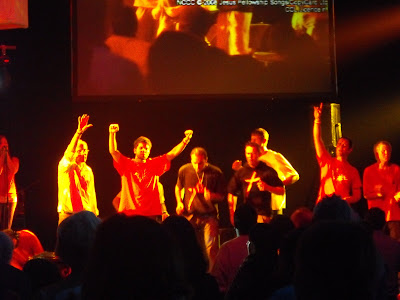



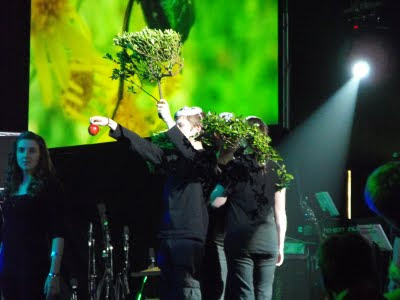


Here's some photos of our recent big bash in Sheffield: the Jesus Fellowship Praise Day last Saturday:


Subscribe to:
Posts (Atom)